Over the past two decades, Europe has faced a series of economic challenges—financial crises, slow productivity growth, geopolitical tensions, energy shocks, and the lingering effects of the COVID-19 pandemic. Amid these pressures, one sector has consistently acted as a stabilizing force: the services sector. Often overshadowed in public discourse by manufacturing and industrial output, services have quietly become the backbone of Europe’s economy.
Today, services account for roughly 70% of the European Union’s GDP and employment, making them the dominant force in economic activity . In terms of value creation, they represent around 73% of total gross value added (GVA) across the EU . These figures alone demonstrate that Europe is no longer primarily an industrial economy—it is a service-driven one.
This article explores how the services sector is not only sustaining Europe’s economy but actively “saving” it—by driving growth, creating jobs, supporting other industries, and enabling resilience during crises.
Understanding the Services Sector
The services sector includes a wide range of activities that provide intangible value rather than physical goods. These include:
- Financial services (banking, insurance, fintech)
- Professional services (legal, consulting, accounting)
- Information technology and digital services
- Healthcare and education
- Tourism, hospitality, and retail
- Transportation and logistics
Unlike manufacturing, which produces tangible products, services rely heavily on knowledge, expertise, and human capital. This makes them particularly adaptable in a modern, digital economy.
Importantly, services are not isolated—they are deeply interconnected with every other sector. For example, manufacturing firms rely on logistics, IT support, marketing, and financial services to function efficiently.
The Shift from Industry to Services
Structural Transformation
Europe’s economic structure has undergone a significant transformation. Historically, industrial production dominated economies like Germany, France, and the United Kingdom. However, over time, globalization, automation, and technological progress have reduced the relative importance of manufacturing.
In contrast, services have expanded rapidly. This shift is part of a broader global trend, where advanced economies transition toward knowledge-based industries.
Reasons Behind the Shift
Several factors explain this transition:
- Automation in manufacturing reduces labor demand
- Global competition shifts production to lower-cost regions
- Rising incomes increase demand for services such as healthcare, education, and entertainment
- Digitalization creates entirely new service categories
As a result, services have become the primary engine of economic activity in Europe.
Services as the Engine of Economic Growth
Dominance in GDP
Services dominate Europe’s economic output. With around 70% of GDP coming from services, the sector is the main contributor to overall growth .
This dominance means that even modest growth in services can significantly impact the entire economy. In contrast, stagnation in manufacturing has a smaller overall effect due to its reduced share.
Post-Pandemic Recovery
After the COVID-19 pandemic, services played a critical role in economic recovery. While all sectors experienced sharp declines in early 2020, services rebounded strongly.
By 2025, EU service production had grown by 16.4% compared to pre-pandemic levels, far outpacing industrial growth .
This recovery was driven by:
- Reopening of tourism and hospitality
- Growth in digital services
- Increased demand for professional and business services
The rapid rebound of services helped offset weaknesses in other sectors, particularly manufacturing and construction.
Job Creation and Employment Stability
Largest Source of Employment
The services sector is the largest employer in Europe, accounting for approximately 70% of total employment .
This includes millions of jobs across diverse industries—from healthcare workers and teachers to software developers and financial analysts.
Labor-Intensive Nature
Unlike manufacturing, which increasingly relies on automation, many service industries are labor-intensive. This makes them crucial for job creation and social stability.
For example:
- Healthcare and education require skilled human professionals
- Hospitality and tourism employ large numbers of workers
- Professional services depend on expertise and human interaction
Cushion Against Unemployment
During economic downturns, services often act as a buffer. While industrial jobs may decline rapidly, service employment tends to be more stable, especially in essential sectors like healthcare and public services.
Supporting and Enhancing Other Sectors
The Concept of “Servitization”
One of the most important ways services support Europe’s economy is through servitization—the integration of services into traditional industries.
Business services alone contribute around 11% of EU GDP and play a key role in enhancing productivity across sectors .
Examples include:
- IT services enabling smart manufacturing
- Logistics optimizing supply chains
- Financial services supporting investment and expansion
- Marketing and consulting improving competitiveness
Value Creation Beyond Products
Modern economies increasingly compete on value rather than volume. Services add value at every stage of the production process—from design and innovation to customer experience.
This means that even manufacturing firms rely heavily on services to remain competitive globally.
Digital Transformation and Innovation
Rise of Digital Services
The digital revolution has significantly boosted the services sector. Europe has become a global leader in areas such as:
- Fintech and digital banking
- Software development
- Cloud computing
- E-commerce
Digital services are highly scalable and can be exported globally, making them a powerful driver of growth.
Knowledge-Based Economy
Services are at the heart of Europe’s transition to a knowledge-based economy. They rely on skills, innovation, and intellectual capital rather than raw materials.
Research shows that services play a key role in economic transformation and competitiveness, acting as a catalyst for growth across industries .
Innovation Ecosystem
The services sector also supports innovation by:
- Funding research and development
- Providing consultancy and technical expertise
- Facilitating collaboration across industries
This innovation ecosystem is essential for maintaining Europe’s global competitiveness.
Resilience During Economic Crises
Stability Compared to Manufacturing
Manufacturing is highly sensitive to global demand, supply chain disruptions, and energy prices. Services, on the other hand, are often more resilient.
For example, during recent economic shocks:
- Digital services continued to grow
- Healthcare and public services remained stable
- Financial services adapted quickly to changing conditions
Example: Recent Economic Challenges
Even as Europe faces energy price shocks and geopolitical tensions, parts of the services sector continue to support economic activity and growth .
This resilience highlights why services are considered a “saving force” for the economy—they provide continuity when other sectors struggle.
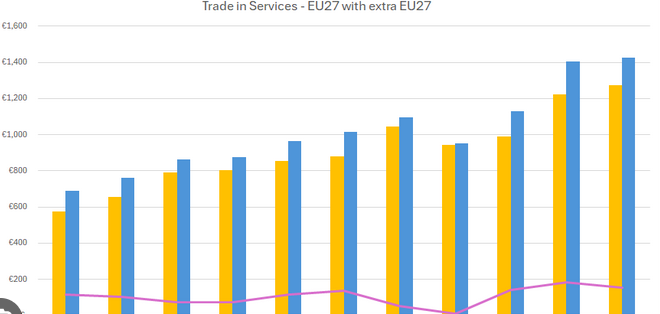
Services and International Trade
Growing Role in Global Trade
Traditionally, trade focused on goods. However, services are becoming increasingly important in international trade.
Europe is a major exporter of services, including:
- Financial services
- Professional consulting
- Digital and IT services
- Tourism
Competitive Advantage
Services give Europe a competitive edge because they rely on expertise and innovation rather than low-cost labor. This allows European companies to compete globally despite higher wage levels.
Untapped Potential
Despite their importance, services account for a relatively small share of intra-EU trade due to regulatory barriers. Reducing these barriers could unlock significant economic growth.
Regional Variations Across Europe
Differences Among Countries
While services dominate across Europe, their share varies by country:
- Luxembourg: around 87% of GVA
- Malta and Cyprus: over 80%
- Poland and Czechia: around 64–66%
These differences reflect variations in economic structure, industrial base, and development levels.
Urban vs Rural Economies
Services are often concentrated in urban areas, where access to skilled labor and infrastructure is greater. Cities like London, Paris, and Berlin serve as hubs for finance, technology, and professional services.
Challenges Facing the Services Sector
Despite its strengths, the services sector faces several challenges:
Regulatory Barriers
The EU’s single market for services is less integrated than its market for goods. Barriers such as:
- Licensing requirements
- Professional qualification recognition
- National regulations
limit cross-border service provision.
Productivity Issues
Some service industries suffer from lower productivity growth compared to manufacturing. This can limit overall economic performance.
Labor Shortages
Many service sectors, especially healthcare and hospitality, face labor shortages due to aging populations and changing workforce preferences.
Digital Competition
Global competition in digital services is intense, particularly from the United States and emerging economies.
The Future of Europe’s Services Economy
Continued Growth
The services sector is expected to remain the dominant force in Europe’s economy. Key growth areas include:
- Digital and AI-driven services
- Green and sustainability-related services
- Healthcare and aging-related services
- Creative and cultural industries
Policy Support
European policymakers are working to strengthen the sector by:
- Reducing regulatory barriers
- Promoting digital transformation
- Investing in skills and education
- Supporting innovation and entrepreneurship
Integration with Other Sectors
The future of Europe’s economy lies in deeper integration between services and other sectors. Manufacturing, for example, will increasingly rely on advanced services such as AI, data analytics, and automation.
Conclusion
The services sector is not just a part of Europe’s economy—it is its foundation. With around 70% of GDP and employment, it drives growth, creates jobs, and supports every other sector .
In times of crisis, services provide resilience. In periods of growth, they act as the main engine of expansion. From digital innovation to professional expertise, services are shaping the future of Europe’s economic landscape.
While challenges remain—particularly in regulation, productivity, and global competition—the overall trajectory is clear. The services sector is not only sustaining Europe’s economy but actively saving it, ensuring stability and prosperity in an increasingly complex global environment.