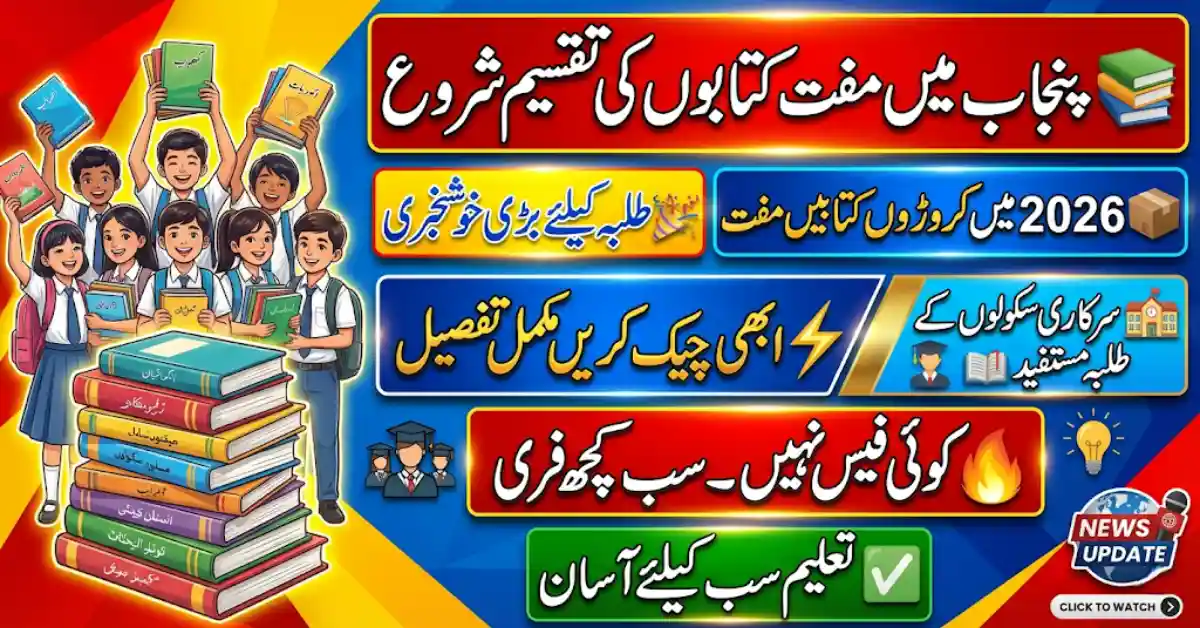
The Punjab government has officially launched the Free Textbook Distribution 2026 program, bringing a major relief for millions of students studying in public schools. With the new academic session kicking off, this initiative ensures that students receive their books on time—without putting any financial burden on families.
Under the supervision of the School Education Department (SED), over 3 crore textbooks are being distributed across the province. This move reflects the government’s continued focus on improving literacy and making education accessible for all.
What is Free Textbook Distribution 2026?
The Free Textbook Distribution 2026 is a large-scale educational support program aimed at providing free books to all students enrolled in government schools. It is part of Punjab’s broader vision to promote equal learning opportunities under initiatives like “Parho Punjab, Barho Punjab.”
Books are printed in bulk and delivered through a well-organized supply chain—from central warehouses to districts, then schools—ensuring smooth and timely distribution. Free Textbook Distribution 2026
Who is Eligible for Free Books?
The eligibility criteria for this scheme are simple and inclusive:
Basic Requirements
- Must be enrolled in a government school in Punjab
- Student record must be updated in the SIS system
- Applicable for classes from Katchi to Grade 10
Additional Points
- Students with regular attendance may be prioritized
- Basic verification like school ID or B-Form may be required
This ensures that all deserving students benefit from the program without complications.
How Does the Distribution Process Work?
The government has streamlined the process to avoid delays:

Step-by-Step Process
- Books arrive at district warehouses
- Delivered to schools via logistics teams
- Verified by school administration through SIS
- Handed over directly to students in classrooms
Monitoring teams also conduct surprise visits to ensure transparency and prevent misuse.
How to Track Book Distribution Status?
Parents and students can stay updated through official channels:
- Schools update distribution status on the SIS portal
- District-wise progress can be checked via the education department website
- In case of delay, parents should contact the headmaster or DEO office
This digital tracking system improves accountability and ensures no student is left behind.
Key Benefits of This Program
The Free Textbook Distribution 2026 brings multiple advantages:
- Students can start studies from day one
- Teachers can follow the syllabus without delay
- Financial burden on parents is reduced
- School attendance improves significantly
Overall, it creates a more equal and effective learning environment.
Latest Update for 2026
The distribution is currently in Phase 1, and most districts have already started receiving books. Authorities have also introduced stricter monitoring to ensure that no school charges any fee for these free textbooks.
Parents are advised to stay in contact with schools and ensure their children receive a complete set.
Conclusion
The Free Textbook Distribution 2026 is a strong step toward educational equality in Punjab. By providing free books to millions of students, the government is removing a major barrier to learning.
Parents should make sure their children are present during distribution days and verify that all books are received properly. Remember, these books are completely free, and any complaint of overcharging should be reported immediately.
FAQs for Free Textbook Distribution 2026
1. Are textbooks really free in 2026?
Yes, all textbooks provided under this scheme are completely free for government school students.
2. What if my child gets incomplete books?
Contact the school headmaster. Missing books will be arranged from the district stock.
3. Can private school students get free books?
Generally no, but some partner schools under special programs may receive them.
4. How to verify official textbooks?
Original books have a “Not for Sale (Muft)” label and may include a QR code.
5. When will all students receive books?
Distribution is ongoing in phases and expected to complete early in the academic session.